
 EN
EN
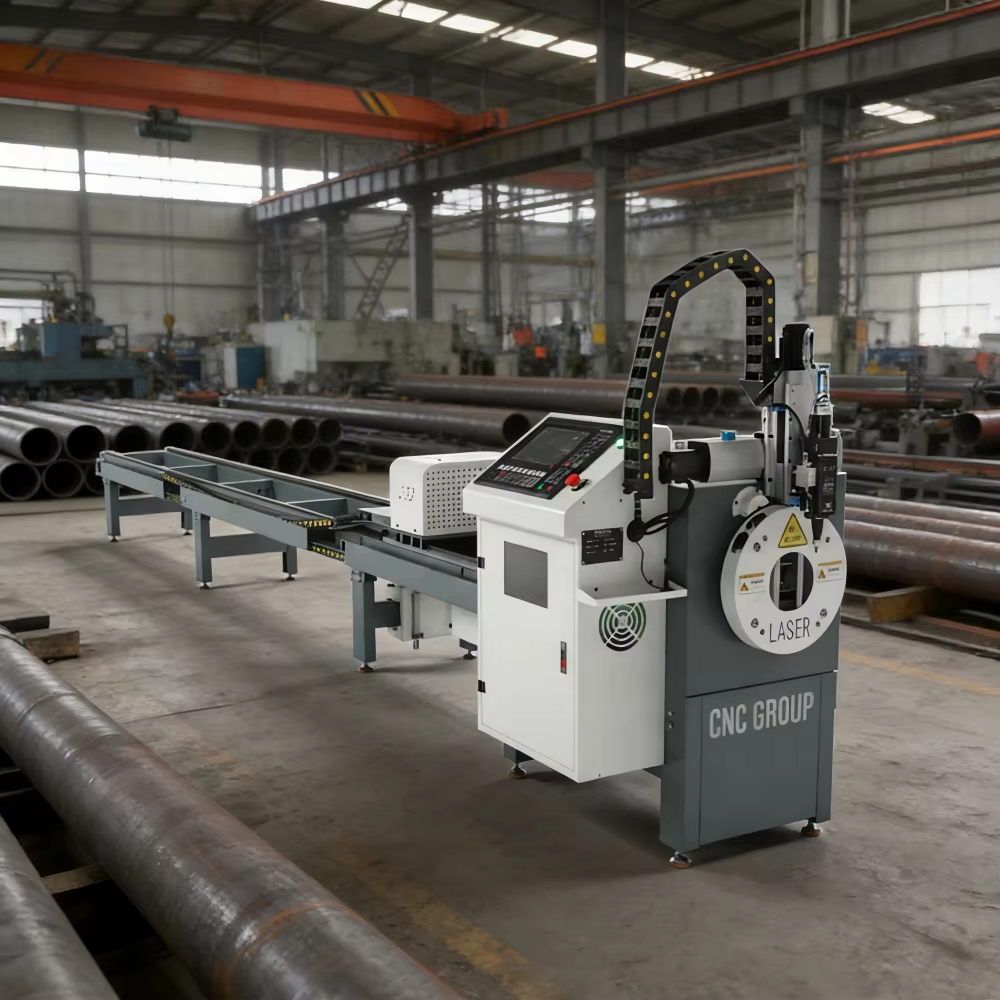
The Technology Behind Industrial Laser Cutting
A laser cutter generates a focused beam of amplified light — typically from a fiber laser source in modern industrial systems — that concentrates energy into a spot diameter of 50–100 microns. At this focal point, power density reaches approximately 1–10 MW/cm², sufficient to melt or vaporize metal within microseconds of beam contact. The cutting process uses assist gas — oxygen for mild steel to trigger an exothermic reaction that doubles effective cutting speed, or nitrogen for stainless steel and aluminum to expel molten material without oxidation.
Fiber laser sources have replaced CO₂ lasers in most industrial cutting applications because they convert approximately 30–40% of input electrical power into laser output, compared to 10–15% for CO₂ sources. The higher efficiency reduces electricity consumption and eliminates the laser gas mixture — helium, nitrogen, CO₂ — that CO₂ systems require for beam generation. Maintenance shifts from gas management and mirror alignment to occasional diode module replacement, typically after 50,000–100,000 operating hours.
A construction equipment manufacturer producing excavator components upgraded from CO₂ to fiber laser after calculating that the fiber source's higher cutting speed on 6–10mm mild steel — approximately 40–60% faster — would recover the capital cost difference within 14 months through increased throughput. Eliminating laser gas refills saved $12,000 annually in consumable costs.
Material Capability Spectrum
Ferrous Metal Cutting Performance
A fiber laser cutter operating at 1–3kW cuts mild steel up to 12–16mm thickness with oxygen assist gas, producing a clean, square edge suitable for welding without secondary preparation. The oxygen reacts with the molten steel in an exothermic reaction that contributes approximately 60% of the cutting energy, effectively doubling the cutting speed compared to nitrogen-assisted cutting at the same power level.
Stainless steel cutting uses nitrogen assist gas to prevent oxidation at the cut edge, maintaining the chromium oxide passive layer that provides corrosion resistance. Nitrogen cutting of stainless steel at 3kW typically achieves clean cuts through 8–10mm thickness with a bright, oxide-free edge requiring no post-cut cleaning.
Carbon steel cutting thickness capability scales almost linearly with laser power up to approximately 6kW, after which the relationship flattens because the assist gas cannot efficiently expel molten material from the increasingly thick kerf. Practical maximum thickness for fiber laser cutting of carbon steel under production conditions is approximately 25–30mm at 12–15kW.
Non-Ferrous Metal Considerations
Aluminum presents two challenges: high thermal conductivity rapidly conducts heat away from the cut zone, and high reflectivity at fiber laser wavelengths (approximately 1070nm) can reflect beam energy into the optical system. Modern fiber lasers include back-reflection protection that monitors reflected energy and automatically reduces power or interrupts the beam.
Copper and brass cutting at fiber laser wavelengths is practical on systems with beam quality optimized for reflective materials. The key parameter is the beam parameter product (BPP) — a measure of focusability — with lower BPP values achieving the power density needed to overcome copper's thermal conductivity. Copper up to 4–6mm can be cut at 3kW on systems with BPP below 2 mm·mrad.
Cutting Quality Parameters
Kerf Width and Dimensional Accuracy
The kerf — the width of material removed by the laser beam — typically measures 0.15–0.5mm depending on material thickness, laser power, and focal position. The kerf width determines the minimum internal feature size: a slot narrower than roughly 1.5 times the kerf width cannot be cut because the beam removes material from both sides, converging to a single cut rather than two parallel edges.
Dimensional accuracy on modern fiber laser cutting machines achieves ±0.05–0.1mm for thin materials (1–3mm) and ±0.1–0.3mm for thicker materials (6–12mm). Thermal distortion — the expansion and contraction of the sheet during cutting — becomes the dominant accuracy limitation above approximately 10mm thickness because the heat-affected zone extends further from the cut edge.
Edge Quality and Secondary Operations
Laser-cut edges on mild steel with oxygen assist gas exhibit a thin oxide layer requiring removal before painting or powder coating. Nitrogen-cut stainless steel and aluminum edges are paint-ready without cleaning. The cut edge roughness (Rz) typically measures 10–30μm on properly optimized parameters, comparable to a machined surface requiring minimal preparation before welding.
The heat-affected zone (HAZ) — the region where material properties change due to cutting heat — extends 0.1–0.3mm from the cut edge on thin materials and 0.3–0.8mm on thicker sections. The narrow HAZ minimizes the post-cut heat treatment that thicker sections might require after plasma cutting, where the HAZ can extend 2–4mm.
Frequently Asked Questions
What thickness of mild steel can a 3kW fiber laser cutter handle?
A 3kW fiber laser cuts mild steel up to 12–16mm with oxygen assist gas and 6–8mm with nitrogen for oxide-free edges. Cutting speed decreases exponentially with thickness — 16mm cuts at approximately 0.6–0.8 m/min compared to 3–4 m/min for 3mm material.
How does fiber laser compare to CO₂ laser for industrial cutting?
Fiber lasers offer 2–3× higher electrical efficiency (30–40% vs 10–15%), faster cutting on thin to medium materials, elimination of laser gas consumables, and lower maintenance. CO₂ lasers retain an edge quality advantage on materials above 15mm thickness due to different beam absorption characteristics.
What assist gas is best for stainless steel laser cutting?
Nitrogen at 99.95%+ purity produces bright, oxide-free edges on stainless steel without post-cut cleaning. Oxygen cutting is faster but leaves an oxidized edge requiring removal before welding or coating. Rayman CNC laser cutting machines support automatic gas selection and pressure control for both gases.
Can a fiber laser cutter process reflective materials like aluminum and copper?
Yes, modern fiber lasers with back-reflection protection systems cut aluminum up to 12–16mm (3kW) and copper up to 4–6mm. Systems with beam parameter product (BPP) below 2 mm·mrad achieve higher power density for reflective materials.
What maintenance does a fiber laser cutter require?
Protective lens cleaning or replacement every 200–500 hours, linear guide lubrication weekly, assist gas filter changes monthly, and chiller coolant replacement annually. Fiber laser sources typically require no maintenance for 50,000+ operating hours before diode module service.
How precise are laser-cut parts compared to machined components?
Laser cutting achieves ±0.05–0.3mm dimensional accuracy (material-dependent), sufficient for weld-ready parts without machining. True machined tolerance (±0.01–0.02mm) remains beyond laser capability — parts requiring such precision need post-cut machining regardless of cutting method.