
 EN
EN
The Logistics Bottleneck Nobody Talks About
Every warehouse manager knows the feeling. Orders are flowing, picking stations are running at full speed, conveyors are humming — and then everything stops at the dock. Boxes pile up. Pallet wrappers sit idle. Forklift drivers scramble to keep pace. The bottleneck was never upstream; it was sitting at the end of the line the entire time. For many operations, the decision point arrives when it becomes clear that adding more people to the dock no longer solves the problem — and that is exactly when a robot palletising system moves from a theoretical upgrade to the only practical next step.
End-of-line palletising has quietly become one of the most expensive blind spots in modern logistics. A robot palletising system addresses exactly this gap — but understanding why it matters starts with recognizing what manual palletising actually costs. For warehouse operators weighing the jump into palletising automation, the decision has less to do with the technology itself and more to do with what happens when end-of-line stacking remains a purely manual operation.
When End-of-Line Operations Become the Weakest Link
Automated storage and retrieval systems, high-speed sorters, and conveyor networks have transformed upstream warehouse automation over the past decade. Yet at the final stage — stacking goods onto pallets for shipment — many facilities still rely entirely on human labor.
This mismatch creates a predictable failure pattern. When inbound order volume spikes, palletising stations become overwhelmed. Throughput at the dock drops. Shipping deadlines slip. The upstream investment in speed gets erased by a downstream bottleneck that nobody planned for.
A well-integrated robot palletising system removes this dependency. Instead of treating palletising as an afterthought, it positions end-of-line automation as a throughput multiplier that protects the return on every dollar already spent upstream.
The Hidden Costs of Manual Palletising
Direct labor expense is the most visible cost, but it is rarely the largest. The deeper losses accumulate quietly — in ways that never appear on a single line item.
Inconsistent stacking patterns cause pallet instability. Loads shift during transport. Product arrives damaged. Returns spike, customer relationships strain, and freight claims increase. Over time, these secondary costs consistently outweigh the hourly wage of the worker stacking the pallet.
Injury risk represents another compounding expense. According to OSHA injury data, musculoskeletal disorders from repetitive lifting and awkward postures remain among the most common workplace injuries in warehousing environments. Each incident triggers workers' compensation claims, lost productivity, and in severe cases, regulatory scrutiny. A single back injury at a palletising station can carry a total cost far exceeding the annual payment on an automated palletising cell.
Then there is the capacity ceiling. Manual palletising cannot scale linearly. Adding more workers requires more floor space, more supervision, and more training — and during peak seasons, finding qualified temporary labor is not guaranteed. Facilities that hit this wall often discover that their maximum throughput is determined not by their picking speed, but by how many pallets human hands can build per hour.
Why a Robot Palletising System Changes the Equation
What makes automated palletising fundamentally different is not just speed — it is repeatability. A robotic arm does not get tired after four hours. It does not vary its stacking pattern from shift to shift. It does not call in sick during the busiest week of the quarter.
Consistent stacking quality directly reduces product damage and freight claims. A robotic arm performing layer palletising builds each tier identically — every case in the same position, at the same angle, with the same placement force. Uniform pallet loads make downstream handling more predictable — whether the pallet is going into a stretch wrapper, a truck, or a high-bay racking system. Warehouses that adopt automated palletising commonly report damage rate reductions of 40% to 70% within the first year, simply because every layer is built identically, every time.
Beyond quality, the capacity argument is straightforward. A single palletising robot running two shifts handles throughput that would require three to four full-time workers — without the overhead of recruitment, training, or turnover. When order volumes spike, the robot runs an extra shift. When volumes drop, it waits. That flexibility changes how logistics managers think about staffing during seasonal peaks.
How a Robot Palletising System Actually Works
Understanding how automated palletising functions at a technical level makes the selection process far more practical. A robot palletising system is not a black box — it is a coordinated set of mechanical, electrical, and software subsystems working together.
Core Components That Make Automated Palletising Possible
Every robotic palletising cell shares a common anatomy, regardless of brand or application. The four essential building blocks are:
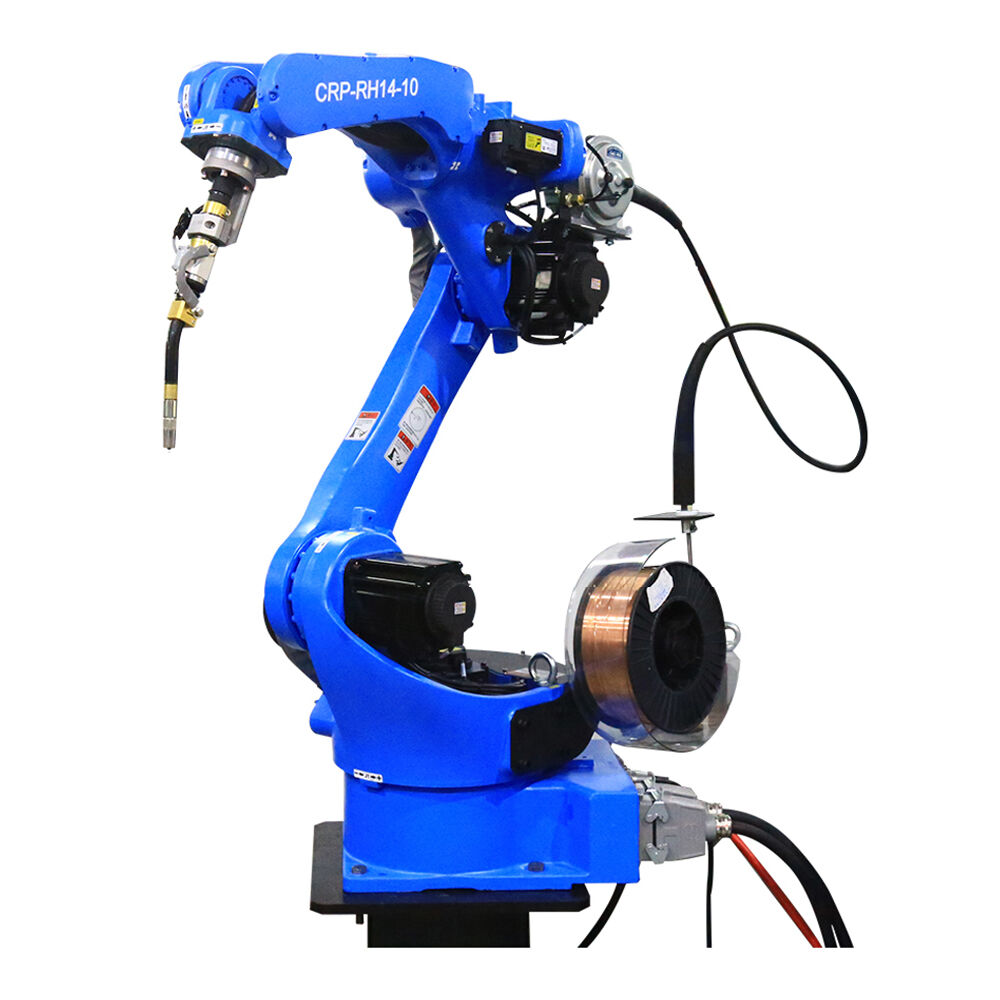
The robotic arm. Typically a 4-axis or 6-axis articulated industrial robot, selected primarily for payload capacity and reach. Four-axis robots dominate simple case-palletising applications because they offer sufficient degrees of freedom at lower cost. Six-axis arms handle more complex tasks — reorienting products, building mixed-SKU pallets, or reaching across multiple infeed positions.
The infeed conveyor system. Product must arrive at the robot in a consistent orientation and spacing. Infeed conveyors handle this by metering cartons, cases, or bags into a pick zone where the robot's vision system or sensors can locate each item. Belt conveyors serve light-to-medium loads; roller conveyors manage heavier cases and bulk bags.
The end-of-arm tooling (EOAT). This is where the most important engineering decisions live. The gripper attached to the robot's faceplate determines what the system can handle — and what it cannot. EOAT selection is covered in detail below.
The pallet-handling subsystem. Empty pallets must be dispensed automatically, and full pallets must be discharged without human intervention. Pallet dispensers, transfer cars, and discharge conveyors complete the loop so the robot never waits for an operator to swap a pallet.
End-of-Arm Tooling — The Gripper Decision That Determines Everything
Ask any integrator what causes palletising projects to underperform, and the answer almost always traces back to gripper selection. The robotic arm itself is rarely the limiting factor; the tooling at the end of it is. The palletising gripper determines handling speed, product compatibility, and ultimately the return on the entire cell.
Vacuum grippers dominate lighter applications — cartons, shrink-wrapped bundles, and consumer packaged goods. They use Venturi generators or electric vacuum pumps to create suction across an array of cups or foam pads. The advantage is gentle handling and fast cycle times. The limitation is weight: vacuum grip weakens as product mass increases, and porous surfaces like corrugated cardboard require higher flow rates to maintain hold.
Clamp-style grippers handle heavier, more rigid loads — bags of cement, chemical sacks, or boxed industrial components. Side-mounted paddles squeeze the load from two directions. Clamping force must be calculated precisely: too little grip and the load drops; too much and the packaging crushes. Force-limited pneumatic cylinders with proportional control valves are the standard approach for applications where product integrity matters.
Fork-style and bag grippers serve niche applications. Forks slide under loads that cannot be clamped or vacuumed — open-top containers, trays of produce, or unstable stacks. Bag grippers use penetrating needles or pinch mechanisms for woven polypropylene sacks common in agricultural and chemical industries.
The practical takeaway: gripper selection should happen before the robot is specified, not after. The product dictates the gripper. The gripper dictates the payload requirement. And the payload requirement dictates which robotic arm is appropriate. Reversing this order leads to expensive rework.
Software, Sensors, and Safety: The Intelligence Layer
A modern palletising cell does more than repeat a taught path. Palletising software calculates optimal stacking patterns — layer by layer, row by row — based on case dimensions, pallet size, weight distribution, and stability constraints. Sophisticated systems handle both palletising and depalletising workflows, switching between stacking outbound orders and breaking down inbound pallets of raw materials or returns. Pattern generation happens automatically: the operator enters product parameters, and the software produces a stack pattern that maximizes load density while maintaining stability during transport.
Vision systems add flexibility. Cameras mounted above the infeed conveyor identify product position and orientation, allowing the robot to perform pick-and-place operations on items that are not perfectly aligned. This eliminates the need for precise mechanical positioning upstream and enables mixed-SKU pallet building — where different products are stacked on the same pallet in a customer-specific arrangement.
Safety architecture follows ISO 10218-1 and ISO 10218-2, the international standards governing industrial robot safety. Perimeter guarding — typically modular fencing with interlocked access gates — creates a physical boundary between the robot's workspace and human personnel. Safety-rated monitored stop functions bring the arm to a controlled halt when a gate opens. Light curtains or laser area scanners provide additional protection at pallet entry and exit points. In collaborative applications where a cobot and human share workspace, ANSI/RIA R15.06 defines the power-and-force-limiting requirements that keep contact forces below injury thresholds.
Real-World Impact: From Manual Stacking to Automated Precision
Abstract capabilities matter less than what happens on the warehouse floor. The difference between manual and robotic palletising becomes clearest when examined through an actual deployment.
A Food Distribution Center's Transition to Robotic Palletising
A regional food distribution center in the Midwest operated a 60,000-square-foot dry-goods warehouse serving grocery chains across three states. The facility processed approximately 4,500 cases per day through manual palletising stations staffed by six full-time operators across two shifts.
The problem was not volume — it was consistency and labor availability. Stacking quality varied significantly between operators and shifts. Pallet instability caused an average of 12 load collapses per month, each requiring rework and often resulting in product damage. During the summer peak, the facility struggled to staff all palletising positions. Overtime costs climbed, and temporary workers required constant supervision, which pulled supervisors away from other responsibilities.
The facility installed a single articulated-arm palletising cell with a vacuum EOAT configured for mixed-case handling. The system was integrated with existing conveyors and paired with an automatic pallet dispenser and discharge lane.
Within six months of commissioning, measurable improvements emerged: case throughput per palletising station increased by 58%; load collapses dropped from 12 per month to fewer than 2; product damage claims fell by 62%; and full-time palletising headcount was reduced from six to two, with the remaining staff redeployed to quality control and order verification roles.
The payback period on the equipment investment — calculated against labor savings, damage reduction, and avoided overtime — landed at approximately 19 months.
Measurable Gains in Speed, Accuracy, and Worker Safety
The case above illustrates patterns that repeat across industries. Throughput typically improves by 40% to 80% when a manual station is replaced by robotic palletising, depending on case weights and stacking complexity. Damage rates consistently decline because every layer is placed with the same force and alignment. And the ergonomic benefit — removing workers from repetitive heavy lifting — produces safety improvements that OSHA recordable injury logs reflect within the first year.
One metric that catches many operators by surprise is pallet quality downstream. Forklift drivers notice immediately: stable, square loads handle predictably. Truck loading time decreases because pallets fit cleanly into trailers without rework. Automated stretch wrappers produce better wrap quality on uniformly stacked loads. These downstream effects compound, generating savings that extend well beyond the palletising station itself.
How to Evaluate a Robot Palletising System for Your Operation
The technology is mature. The business case is clear. The harder question is: which system fits this specific facility? Answering that requires methodical evaluation, not a feature checklist.
Five Questions to Ask Before Looking at a Palletising Robot
What is the product mix, and how often does it change? A facility handling six SKUs with consistent case dimensions has different needs than one handling 200 SKUs with dimensional variability. The wider the product range, the more valuable flexible tooling and vision-guided picking become.
What are the peak throughput requirements — in cases per minute, not per day? Daily averages hide demand spikes. A robot palletising cell must be sized for the peak hour, not the average hour. Measure the maximum sustained case rate arriving at the palletising station during the busiest 60-minute window of the week.
What are the pallet configurations — single-SKU, mixed-SKU, or both? Single-SKU pallets are simpler to automate. Mixed-SKU pallets — where different products are stacked on one pallet in a sequence dictated by a store planogram or customer requirement — demand more sophisticated software and often a 6-axis arm with a flexible gripper.
Is the facility layout ready for integration, or will floor space need reconfiguration? Robotic cells require clear zones for infeed, discharge, pallet supply, and maintenance access. Underestimating the footprint — especially around the pallet dispenser and discharge conveyor — is one of the most common planning errors.
What is the realistic maintenance capability on site? A palletising robot from a supplier with remote diagnostics, accessible spare parts, and responsive local support will deliver higher uptime than one chosen on price alone. Maintenance readiness should be part of the selection criteria from the start.
Reading the Spec Sheet — Payload, Reach, and Cycle Time That Matter
Three numbers define a robot's physical capability for palletising:
Payload capacity must include more than the product weight. Add the weight of the gripper, any mounting bracket, and a safety margin of at least 15%. A system specced for 50 kg cases with a 12 kg gripper needs a payload rating of at least 72 kg — not 50 kg.
Reach determines how tall a pallet the robot can build and how many infeed positions it can access without repositioning. For pallet heights exceeding 1.8 meters, the robot's vertical reach must account for the gripper height at the top layer plus clearance for safe retraction.
Cycle time — the time from pick to place and return — dictates peak throughput. A robot that completes 10 cycles per minute handling one case per cycle achieves 600 cases per hour. If the peak requirement is 720 cases per hour, either cycle time must improve or a dual-gripper configuration that handles two cases per cycle becomes necessary. Realistic cycle time calculations should use sustained performance data, not maximum-speed marketing figures.
Frequently Asked Questions
What is a robot palletising system and how does it work?
A robot palletising system is an automated end-of-line solution that uses an industrial robotic arm, end-of-arm tooling, and integrated conveyors to stack products onto pallets. It receives cases from an infeed conveyor, calculates optimal stacking patterns through palletising software, and places each item with programmed precision — building stable, uniform pallet loads without human intervention.
How much does a palletising robot cost?
Entry-level palletising cells typically range from 150,000 for standard case-handling applications. Mid-range systems with vision guidance and flexible tooling run 250,000. Complex installations with multiple infeed lanes, mixed-SKU capability, and high-speed layer handling can exceed $300,000. Payback periods commonly fall between 12 and 24 months when labor savings, damage reduction, and throughput gains are calculated together.
What types of products can a palletising robot handle?
Palletising robots handle cases, cartons, bags, pails, trays, shrink-wrapped bundles, and rigid containers. Product weight, surface texture, and packaging integrity determine gripper choice — vacuum for smooth cartons, clamps for heavy bags, forks for open-top containers. Fragile or irregularly shaped items may require custom end-of-arm tooling.
How long does it take to install and commission a robot palletising system?
A standard single-robot palletising cell typically takes 8 to 14 weeks from order to production handover. This includes system design, fabrication, factory acceptance testing, on-site installation, programming, operator training, and production ramp-up. Complex integrations involving existing conveyor modifications or multiple robots can extend to 16 to 20 weeks.
Can a robot palletising system handle mixed pallets with different SKUs?
Yes, but mixed-SKU palletising requires more capable hardware and software. A 6-axis robot with vision guidance and advanced palletising software can identify multiple product types on the infeed, determine stacking sequence based on weight and stability rules, and build store-ready mixed pallets. This capability is common in food distribution and retail logistics.
What are the safety requirements for a robotic palletising cell?
Safety compliance follows ISO 10218-1/2 and ANSI/RIA R15.06 standards. Required elements include physical perimeter guarding with interlocked access gates, safety-rated monitored stop functions, emergency stop buttons at operator stations, and light curtains or area scanners at material entry and exit points. A documented risk assessment must be completed before commissioning.
What maintenance does a palletising robot require?
Routine maintenance includes weekly inspection of gripper wear components, monthly lubrication of articulated joints per manufacturer schedule, quarterly sensor calibration checks, and annual replacement of consumables such as vacuum cups and pneumatic seals. Most suppliers recommend a preventive maintenance contract covering two to four scheduled visits per year.
When does a collaborative robot make sense over a traditional industrial palletising robot?
Collaborative robots suit low-to-medium-speed applications where payloads stay under 12–15 kg and floor space is constrained. Traditional industrial robots are preferred for high-speed, high-payload operations — cases exceeding 20 kg, cycle times under 5 seconds, or multi-shift continuous production. The trade-off is speed and payload capacity versus flexibility and reduced guarding requirements.
Table of Contents
- The Logistics Bottleneck Nobody Talks About
- When End-of-Line Operations Become the Weakest Link
- How a Robot Palletising System Actually Works
- Real-World Impact: From Manual Stacking to Automated Precision
- How to Evaluate a Robot Palletising System for Your Operation
-
Frequently Asked Questions
- What is a robot palletising system and how does it work?
- How much does a palletising robot cost?
- What types of products can a palletising robot handle?
- How long does it take to install and commission a robot palletising system?
- Can a robot palletising system handle mixed pallets with different SKUs?
- What are the safety requirements for a robotic palletising cell?
- What maintenance does a palletising robot require?
- When does a collaborative robot make sense over a traditional industrial palletising robot?