
 EN
EN
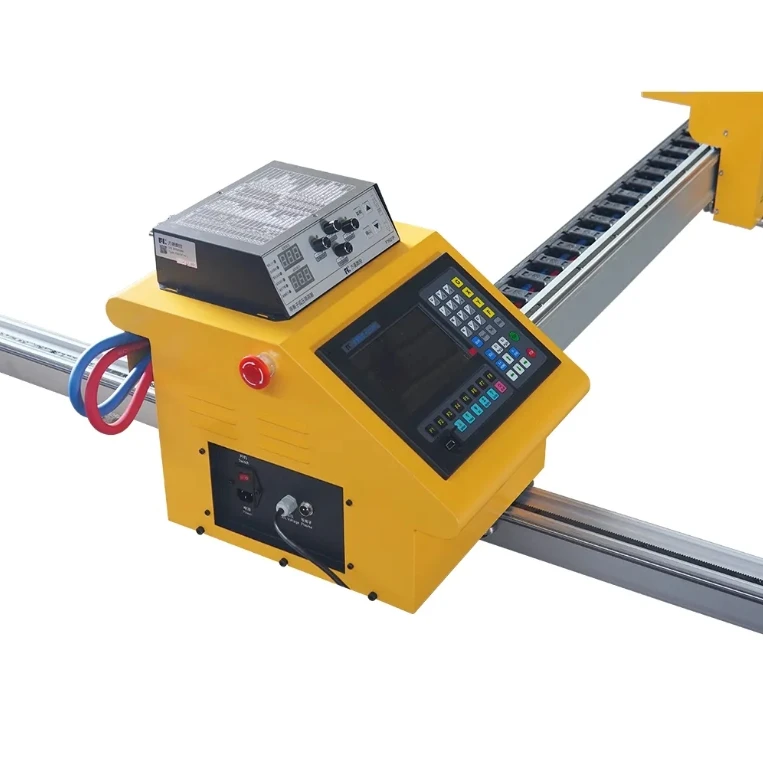
The CNC System's Role in Cutting Accuracy
A laser cutting machine CNC controller translates part geometry from CAD files into synchronized motion commands for the cutting head and workpiece positioning axes. The controller's motion planning algorithm — how it calculates acceleration, deceleration, and cornering trajectories — determines whether the machine cuts sharp corners accurately or rounds them off at high speed. Precision in laser cutting is as much about motion control as it is about beam quality.
The CNC system processes G-code generated by CAM software from the part geometry. Each line of G-code specifies a target position and feed rate. The controller's trajectory planner calculates the velocity profile between positions: accelerating from the previous point, maintaining cutting speed through the straight segment, and decelerating into the corner at a speed that prevents overshoot. The corner deceleration decision — how much to slow down and how close to the corner to begin deceleration — determines corner sharpness.
A sheet metal fabricator producing stainless steel enclosures for medical equipment found that corner rounding on 1.5mm material — 90-degree corners becoming 2–3mm radii at 3 m/min cutting speed — caused assembly fitting problems. The solution was look-ahead trajectory planning that automatically reduced speed through corners while maintaining full speed on straight segments. Corner accuracy improved to within 0.2mm of programmed geometry without sacrificing cycle time.
Motion Control Architecture
Servo Drive Systems
The CNC controller sends position commands to servo drives that control the motors moving the cutting head gantry and workpiece table. AC servo motors with absolute encoders provide position feedback with resolution of approximately 1–5 microns per encoder count, enabling the controller to verify that the axis reached the commanded position rather than assuming it did based on steps sent to the motor.
The servo response bandwidth — how quickly the motor can accelerate and decelerate — determines how sharply the machine can change direction at a given speed. Higher bandwidth servos achieve tighter cornering at higher feed rates. The mechanical stiffness of the gantry structure limits practical servo bandwidth: commanding acceleration that the structure cannot deliver causes vibration and cut quality degradation.
Dual-drive gantry configurations — independent motors on both sides of the bridge axis — require the CNC controller to synchronize both motors within microseconds to prevent the gantry from racking, where one side leads the other and the cutting head tilts relative to the workpiece. Modern CNC controllers maintain synchronization within 0.1mm position difference between gantry sides.
Acceleration and Jerk Control
Jerk — the rate of change of acceleration — affects cut quality more than peak acceleration. A sudden change in acceleration creates mechanical vibration that translates to cut edge waviness, particularly visible on straight cuts parallel to the gantry axis. CNC controllers implementing S-curve acceleration profiles — where acceleration ramps smoothly from zero to maximum rather than jumping instantaneously — reduce vibration-induced edge roughness.
The trade-off is cycle time. S-curve acceleration profiles take longer to reach maximum speed than trapezoidal profiles because the ramp phase adds time to each acceleration event. Modern CNC controllers allow the operator to select the acceleration profile based on the part's precision requirements: S-curve for tight-tolerance parts where edge quality matters, trapezoidal for parts where productivity takes priority over sub-0.1mm precision.
Precision Verification Methods
Laser Interferometer Calibration
Positioning accuracy verification uses a laser interferometer — a measurement system using the wavelength of laser light (632.8nm for helium-neon lasers) as a reference standard. The interferometer measures the actual axis movement versus the commanded position with resolution below 1 micron, generating a positioning error map across the machine's travel range.
The CNC controller uses this error map for volumetric compensation: applying a correction factor at each position to offset the mechanical errors in the ballscrew pitch, linear guide straightness, and gantry squareness that accumulate across the working envelope. A machine traveling 3,000mm may have accumulated positioning error of 30–50 microns without compensation; with interferometer-mapped compensation, the same machine achieves ±20–30 microns positioning accuracy across the full travel.
Test Cut Validation
Test cut patterns — typically squares, circles, and diamond shapes cut at programmed dimensions — verify the CNC-laser combination's precision under actual cutting conditions. Measuring cut parts with a coordinate measuring machine (CMM) or precision calipers reveals the combined effects of positioning accuracy, kerf width compensation, and thermal expansion.
Test patterns should include features near the extremes of the working envelope, where cantilever effects and thermal expansion produce the largest positioning errors. A machine cutting accurately in the center of the table may exhibit 50–100 microns of additional error at the far corner without full-range calibration.
Frequently Asked Questions
What positioning accuracy can a CNC laser cutting machine achieve?
Modern fiber laser CNC machines achieve ±0.03–0.05mm positioning accuracy with interferometer calibration and volumetric compensation. Repeatability — returning to the same position — is typically ±0.02mm. These specifications assume a temperature-controlled environment; shop-floor thermal variation degrades accuracy.
How does CNC look-ahead improve corner cutting quality?
Look-ahead trajectory planning reads 50–200 lines of G-code ahead of the current position, calculating optimal deceleration profiles for approaching corners and acceleration profiles for exiting them. Without look-ahead, the controller reacts to corners one line at a time, causing overshoot and corner rounding.
What maintenance keeps CNC laser cutting precision stable?
Linear guide lubrication, ballscrew inspection for backlash (typically checking every 6 months), and optical path alignment verification. Annual interferometer recalibration compensates for gradual mechanical wear. Rayman CNC laser machine controllers include maintenance interval tracking and diagnostic routines.
How does material thermal expansion affect cutting precision?
Steel expands approximately 12 microns per meter per degree Celsius. A 3-meter sheet at 35°C versus the 20°C calibration temperature expands approximately 0.54mm — exceeding the machine's positioning accuracy specification. Precision applications require temperature-controlled material storage or real-time thermal compensation in the CNC.
What is the difference between absolute and incremental encoders?
Absolute encoders report actual position immediately upon power-up — no homing sequence required. Incremental encoders count pulses from a reference point and require a homing cycle after each power cycle. Absolute encoders prevent position loss from power interruptions during production.
Can older CNC laser cutting machines be retrofitted for better precision?
Controller replacement with modern trajectory planning and servo drives can improve corner accuracy by 50–70% on machines with mechanically sound structures. If the gantry exhibits mechanical wear (backlash exceeding 0.05mm, bearing play), mechanical rebuild must precede controller retrofit for meaningful precision improvement.