
 EN
EN
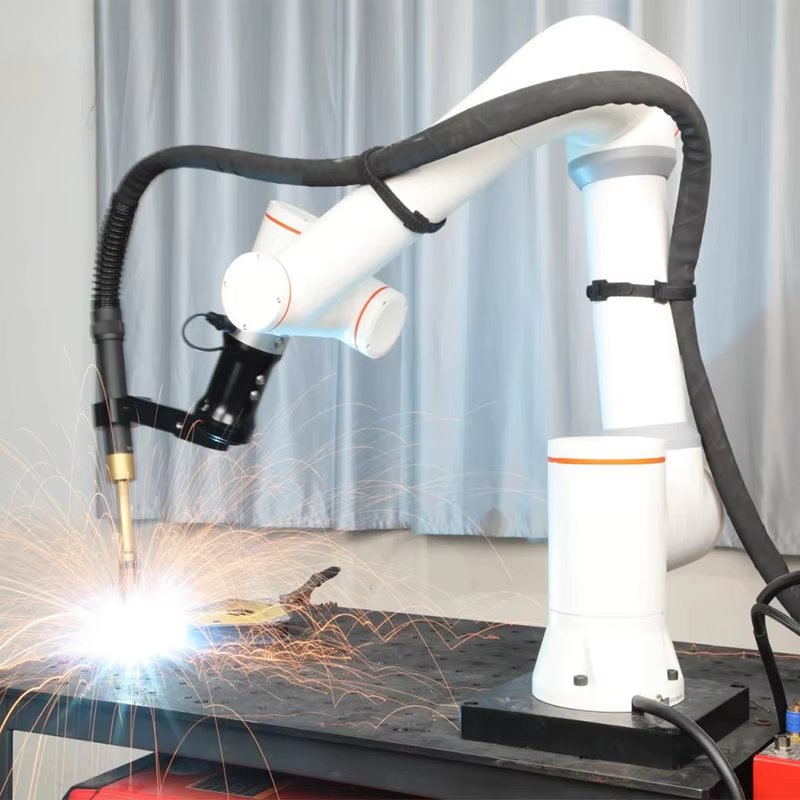
How Collaborative Robot Arm Design Ensures ISO/TS 15066 Compliance
Force-Limiting Mechanics and Real-Time Collision Detection
A collaborative robot arm meets the core safety requirements of ISO/TS 15066—the international standard for human-robot collaboration—through integrated mechanical and control design. The standard mandates that incidental contact must not cause pain or injury, a requirement fulfilled first by strict power and force limiting. Compliant cobots cap contact force at ≤65 N for hand interactions and dynamically limit speed using the standard’s validated formula to ensure forces remain below physiological thresholds. When unexpected contact occurs, real-time collision detection—enabled by high-bandwidth joint torque sensing and motion anomaly algorithms—triggers an immediate, low-inertia stop. This transforms unplanned encounters into transient, low-risk events that preserve workflow continuity without compromising worker safety.
Sensor Fusion Architecture: Torque, Vision, and Proximity Integration
Modern cobot designs meet ISO/TS 15066’s performance-based safety requirements through layered sensor fusion—not reliance on any single safeguard. Joint-mounted torque sensors continuously monitor dynamic force and torque, initiating emergency stops if readings exceed pre-calibrated, task-specific limits derived from the standard’s anthropometric and biomechanical data. Simultaneously, 3D vision systems map the shared workspace in real time, detecting human proximity to activate graded speed reduction before contact becomes possible. Proximity sensors provide redundant, zone-based verification—triggering full stops when workers enter predefined no-go distances. This multi-sensor architecture directly implements ISO/TS 15066’s principle of risk-adaptive control: as human-robot separation decreases, speed and force limits tighten progressively, ensuring consistent, verifiable compliance across operational modes.
Ergonomic Risk Reduction with Collaborative Robot Arm Deployment
Collaborative robot arms reduce ergonomic risk by automating physically demanding tasks—such as lifting heavy components, applying sustained force, or performing high-frequency repetitive motions—that are leading contributors to musculoskeletal disorders (MSDs). By shifting these tasks from humans to cobots, workplaces eliminate exposure to known MSD precursors while retaining human judgment for supervision, quality assurance, and adaptive problem-solving.
Quantifying RSI Reduction in High-Repetition Manufacturing Tasks
Repetitive strain injuries (RSIs) cost manufacturers an average of $740,000 annually per facility in lost productivity and compensation claims (Ponemon Institute, 2023). Cobots mitigate this by assuming cyclic, high-repetition duties like precision part insertion or automated screw driving. In electronics assembly lines, documented deployments show a 72% reduction in RSI incidents—attributable to reduced exposure to forceful exertions and static postures. Workers transition into higher-value roles such as programming, process monitoring, and quality validation, supported by intuitive, teach-by-demonstration interfaces and sensor-driven torque control that maintains safe interaction boundaries during shared tasks.
Case Study: Automotive Supplier Achieves 74% Reduction in Manual Lifting
An automotive components manufacturer experienced rising workers’ compensation claims linked to manual handling of 30 kg transmission housings. After integrating collaborative robot arms equipped with vacuum grippers and ISO/TS 15066-compliant motion control, they achieved:
- 74% drop in lifting-related injuries within eight months
- 30% faster cycle times via uninterrupted material transfer
- Zero safety incidents across 12,000+ collaborative lifts
Operators now program cobots using touch-enabled interfaces and focus on visual inspection and dimensional verification—leveraging human perceptual strengths while offloading biomechanically taxing labor.
Expanding Safe Operations: Collaborative Robot Arm Use in Hazardous Environments
Barrier-Free Automation for Heavy Loads and Extreme Temperatures
Traditional industrial robots require fixed safety barriers—fences, light curtains, or laser scanners—to isolate hazardous motion, limiting flexibility and access in extreme environments like foundries, chemical processing units, or confined-space inspection zones. Collaborative robot arms eliminate this constraint through intrinsic safety: force-limiting joints, real-time collision response, and certified functional safety controllers enable barrier-free operation alongside human support staff. This allows workers to remain outside high-risk zones entirely—removing direct exposure to thermal hazards, toxic agents, or crushing risks—while maintaining responsiveness and adaptability. A 2022 ARC Advisory Group analysis found that robust cobot integration reduces injury-related downtime by up to 18%, with applications spanning hot-metal handling in foundries, remote manipulation of corrosive samples, and autonomous inspection in oxygen-deficient or explosive atmospheres. The result is enhanced protection without sacrificing operational agility.
Behavioral Safety Transformation Through Human–Cobot Collaboration
Traditional safety programs depend heavily on procedural compliance and behavioral training—but fatigue, time pressure, and cognitive overload often erode adherence, contributing to over 80% of industrial incidents (OSHA, 2022). Integrating collaborative robot arms restructures safety at the workflow level: by autonomously managing high-fatigue, high-risk, or monotonous tasks, cobots remove the situational pressures that drive corner-cutting. Workers are no longer forced to choose between speed and safety; instead, cobots enforce consistent, physiologically informed limits—enabling sustained compliance without reliance on vigilance alone. As reported in the International Federation of Robotics’ 2023 Global Market Report, cobot shipments rose 25% year-on-year—driven largely by facilities prioritizing both measurable safety outcomes and throughput gains. Over time, this fosters a culture shift: workers report higher job satisfaction when relieved of physically taxing labor, demonstrate stronger adherence to safety protocols, and engage more proactively in hazard identification and mitigation—creating a self-reinforcing cycle where technology enables—and amplifies—human-centered safety.
FAQ
What is ISO/TS 15066?
ISO/TS 15066 is an international safety standard specifically designed to ensure safe human-machine collaboration by defining force limits and safeguards for collaborative robots.
How do collaborative robots comply with ISO/TS 15066?
Collaborative robots comply by integrating mechanics like force-limiting joints, real-time collision detection, and layered sensor architectures that adapt dynamically to ensure compliance with human-safe force and speed limits.
What ergonomic benefits do cobots offer?
Cobots significantly reduce ergonomic risks by automating physically demanding and repetitive tasks, alleviating factors that contribute to musculoskeletal disorders.
Can collaborative robots operate in hazardous environments?
Yes, they can. Collaborative robots are equipped with intrinsic safety features that allow them to operate without traditional barriers, safeguarding workers while handling tasks in hazardous environments.
How do collaborative robots influence workplace safety behavior?
By automating high-risk tasks and enforcing physiologically informed limits, cobots transform workplace safety, reducing the need for procedural adherence and promoting sustained compliance.